
There is no single best open source PBX, because the honest answer depends on whether you are running phones for one company or selling phone service to many. This page sorts the working options into engines, distributions and platforms, says who each one suits, and records when we last checked that it was still alive.
The previous version of this page recommended software on the strength of how it looked several years ago. Every project below was checked against its own repository in September 2026 before it was listed, and the ones that have gone quiet were moved out of the recommendations and into a section at the end explaining why.
What a PBX is, briefly
A PBX is the switchboard that sits between your phones and the outside line. Internally it routes calls between extensions for nothing. Externally it shares a small number of outside lines, or these days a SIP trunk, across everyone in the building.
An IP PBX does the same job over your network rather than over dedicated phone wiring, which is what makes the rest of it possible: extensions that work from home, call recording, queues, voicemail arriving as email, and a phone system that survives moving office.
The thing that makes these comparisons confusing
Most arguments about open source PBXs are people comparing different layers of the same stack. Asterisk against FreePBX is not a real comparison. Asterisk is an engine with no web interface at all, and FreePBX is a system built on top of Asterisk.
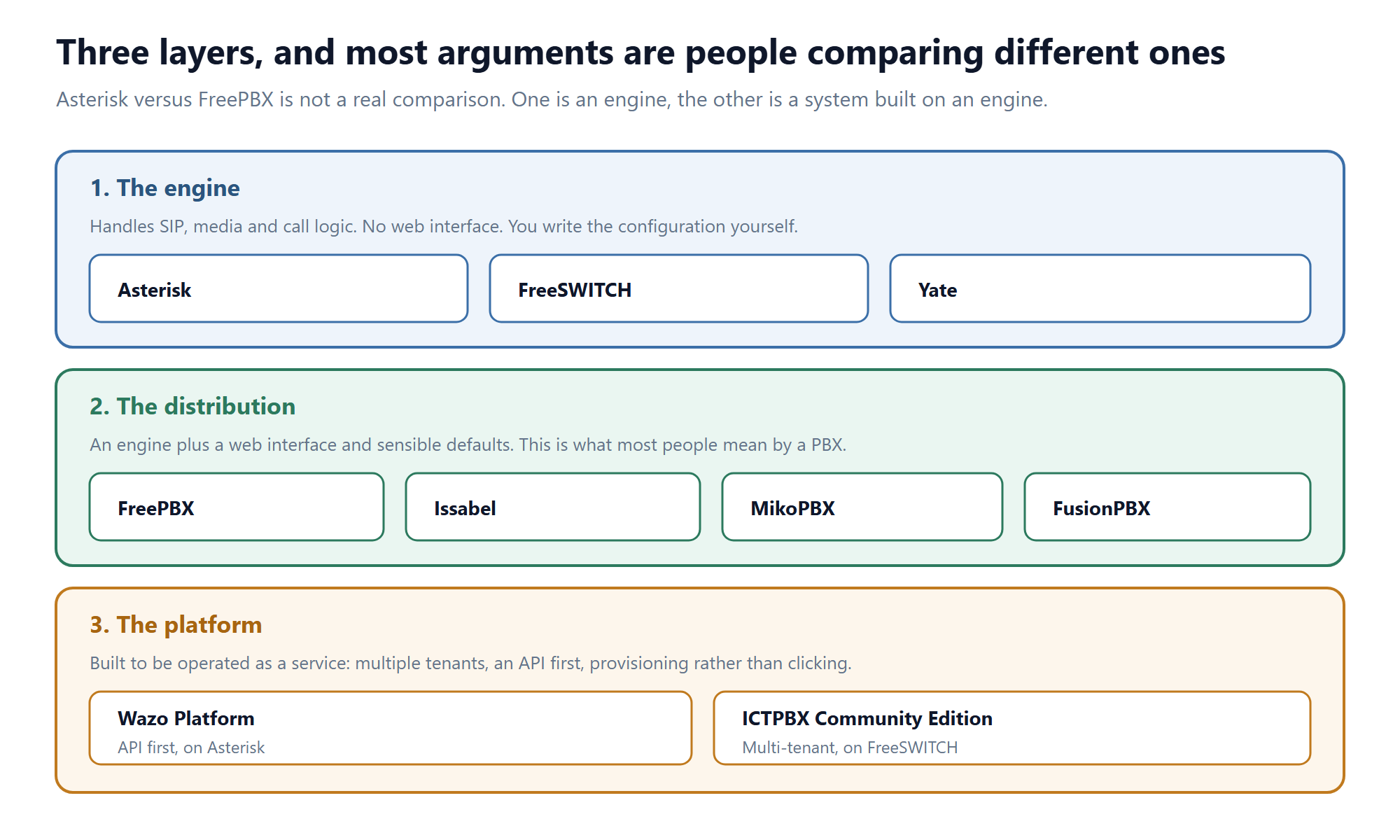
Work out which layer you are shopping in first, and the list gets short quickly.
The engines
Asterisk
Asterisk is the engine underneath a large share of everything else here, including several products people pay for without knowing what is inside. It handles SIP, media, call logic and the dialplan, and it exposes the AMI and ARI interfaces that let you drive calls from your own code.
What it is not is a phone system you can hand to an office. There is no web interface. You write configuration files, or you run something on top of it. Pick Asterisk directly when you are building something specific and the flexibility is the point.
Licence: GPLv2 with a commercial option. Status: very active, commits within days of writing.
FreeSWITCH
FreeSWITCH was started by people who had worked on Asterisk and wanted a different design, particularly around concurrency and media handling. It tends to be the choice when call volume is high or when the media path is doing real work, such as large conferences or transcoding at scale.
It is modular, so you load what you need. It is also less forgiving than Asterisk to learn, with a smaller pool of tutorials, so expect the first week to be slower.
Licence: MPL 1.1. Status: very active.
Yate
Yate is the one most people have never tried. It is a telephony engine rather than a PBX product, and it reaches further down the stack than the other two, into GSM and SS7 territory as well as SIP. If your problem involves talking to mobile network equipment rather than just SIP trunks, it is worth knowing it exists.
For an ordinary office phone system it is the wrong tool, and we would not send a first-time deployment there.
Licence: GPLv2. Status: active, commits this month.
The distributions
FreePBX
FreePBX is the web interface over Asterisk that most of the world actually runs, sponsored by Sangoma. Install the distribution and you have a working phone system in an afternoon rather than a fortnight.
Its real advantage is not the feature list, it is the sheer weight of other people. Whatever goes wrong, somebody has already written up the fix. That matters more than it sounds when a phone system breaks on a Monday morning.
Worth knowing: the base is free and open source, and some of the more advanced modules are commercial add-ons. That is a fair arrangement, but check which side of the line a feature you need sits on before you plan around it.
Licence: GPLv3. Status: active.
Issabel
Issabel is the community continuation of Elastix, built after 3CX bought Elastix and closed the open source versions down. It kept the all-in-one shape: PBX, fax and messaging on one box with one interface.
That breadth is the reason to choose it and also the reason to think twice. Running several services in one appliance is convenient until you need to upgrade one of them.
Licence: GPLv3. Status: active, though at a gentler pace than FreePBX.
MikoPBX
MikoPBX is the newest name on this page and the one we would most encourage people to look at who assume FreePBX is the only option. It is aimed at small businesses, runs on current Asterisk, and the interface is noticeably less cluttered because it is carrying far less history.
The trade is a smaller community. If you like reading forum threads to solve problems, FreePBX still wins. If you would rather the interface simply made sense, start here.
Licence: GPLv3. Status: active, commits within days of writing.
FusionPBX
FusionPBX is the equivalent layer over FreeSWITCH, and it has been the standard answer for multi-tenant deployments on that engine for years. One installation, many separate organisations, each seeing only their own extensions and numbers.
It covers a wide range of jobs beyond the PBX itself, including conferencing, voicemail and fax, and the dialplan editing is genuinely powerful once you are used to it.
Licence: MPL. Status: active.
The platforms
Wazo Platform
Wazo is built for people constructing a communications product rather than administering a phone system. It is API first, so the web interface is one client of the platform rather than the platform itself.
If you are going to drive everything through your own code and your own portal, that design saves an enormous amount of fighting. If you want a box with a login, it is more machinery than you need.
Licence: GPLv3. Status: active.
ICTPBX Community Edition
ICTPBX Community Edition is ours, so read this section with that in mind. It is a multi-tenant IP PBX built on ICTCore and FreeSWITCH with an Angular management interface, released free under MPL 2.0 in May 2026.
It is aimed at the same job as FusionPBX: one installation serving many separate organisations, with each tenant walled off from the others. The differences are that the REST API from ICTCore is the primary interface rather than an afterthought, and there is an Ansible role that installs the whole thing in a single play, which matters when you are standing up more than one of these.
Voice over SIP and fax over T.38 are in the Community Edition. The commercial ICTPBX edition adds white labelling, two-way SMS and an AI voice agent add-on, and those are not in the free edition. We would rather say that plainly here than have you discover it after installing.
Licence: MPL 2.0. Status: active.
So which one
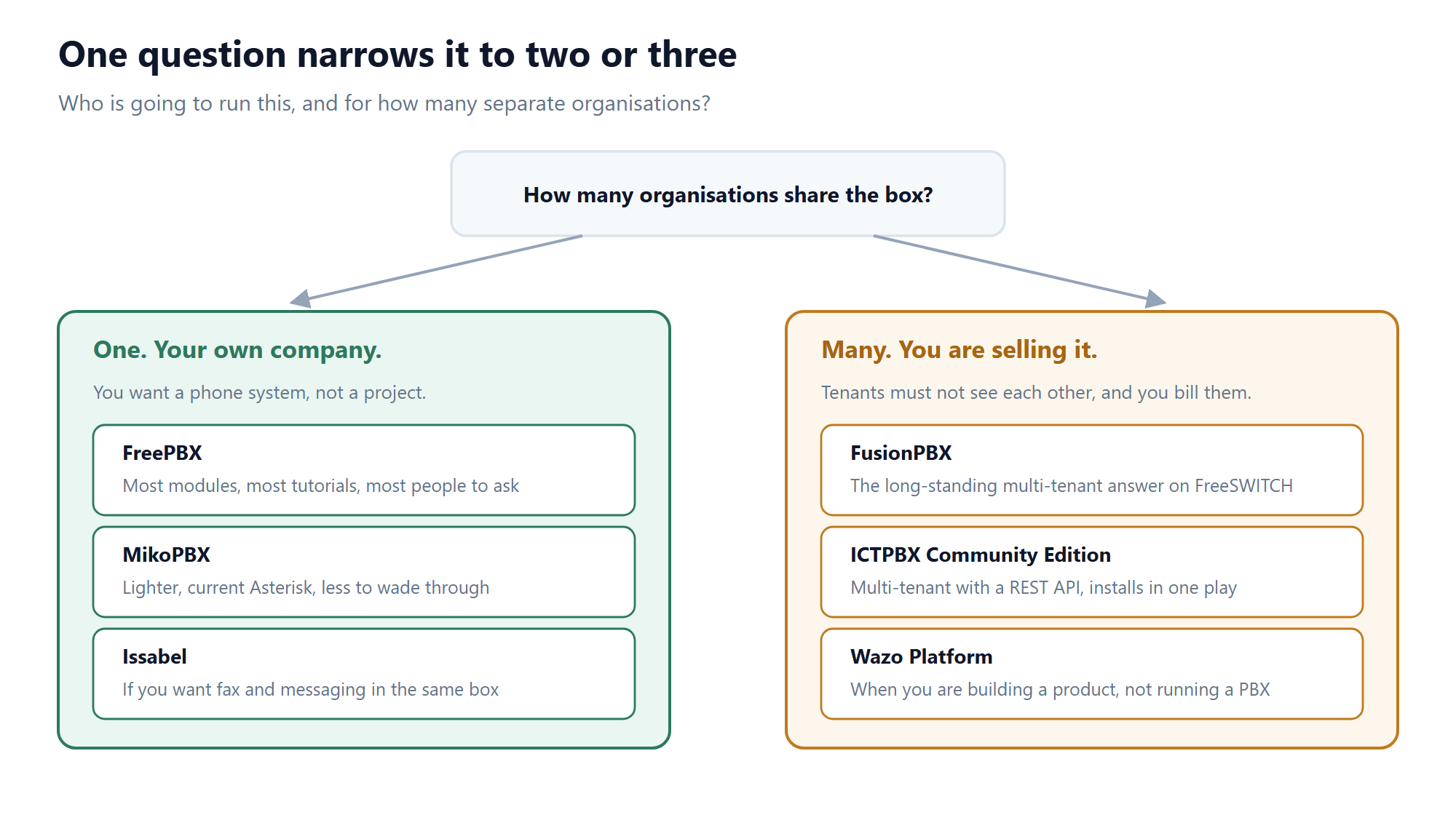
One organisation, and you want phones working this week: FreePBX for the community behind it, or MikoPBX if the FreePBX interface puts you off.
Many organisations on one installation, because you are selling the service: FusionPBX or ICTPBX Community Edition.
You are building a product and the PBX is a component inside it: Wazo Platform, or go straight to Asterisk or FreeSWITCH and write what you need.
What we left out, and why
A roundup that only adds things is not much use, so here is what did not make it.
- Kazoo is a genuinely interesting distributed platform under MPL 2.0, but its repository has had no substantial push in about nineteen months. We have left it off the recommendations rather than send someone into a project we cannot vouch for today.
- sipXcom has been quiet for roughly two years. Same reasoning.
- Elastix appears on a lot of older lists, including our own previous version. The open source editions were discontinued after 3CX acquired it. Issabel is where that community went.
- VitalPBX and 3CX both have free tiers that are widely recommended as open source. They are not. Free to use is a different thing from free to modify and redistribute, and this page is about the second.
If you think we have been unfair to any of these, or a project has picked back up since we checked, tell us and we will recheck it.
Disclosure
One of the nine entries above, ICTPBX Community Edition, is built by ICT Innovations. We have said so in its own section rather than burying it, and it is held to the same test as everything else here: open licence, working repository, and honest about what the free edition does not include. Our other open source work is listed on the open source projects page.
Frequently asked questions
Which open source PBX is easiest for a first deployment?
FreePBX, mainly because of everyone else who has already run into your problem and written about it. MikoPBX is arguably the nicer interface and lighter to run, so it is a close second if you would rather have a clean system than a large forum.
What is the difference between Asterisk and FreePBX?
Asterisk is the engine and has no web interface. FreePBX is a web interface and a set of defaults built on top of Asterisk. You are not choosing between them, you are choosing whether to run Asterisk on its own or with FreePBX in front of it.
Can I run one PBX for several separate companies?
Yes, but only with software designed for it. Multi-tenancy is about keeping each organisation’s extensions, numbers, recordings and billing apart, and bolting that onto a single-tenant system later goes badly. FusionPBX, ICTPBX Community Edition and Wazo Platform are built for it.
Is Asterisk or FreeSWITCH better?
Asterisk if you want the larger ecosystem, more integrations and more people to ask. FreeSWITCH if call volume is high or the media path is doing heavy work such as large conferences or transcoding. Both are actively developed and neither is a mistake.
Is free open source software really enough for a business phone system?
For the software, yes, and plenty of commercial providers are reselling exactly these projects. The cost moves rather than disappears: you still pay for SIP trunks, numbers, phones, a server and somebody who knows how to look after it. Budget for the last one honestly.
How current is this page?
Every project listed was checked against its own repository in September 2026 for activity and licence. Anything that had gone quiet was moved into the section above rather than left in place, because a recommendation list that quietly rots costs readers more time than it saves.